What an AI Retinal Scan Can Reveal About Your Health
Medically reviewed by Pharmacist Cherlyn
The short answer
An AI retinal scan photographs the blood vessels and nerves at the back of your eye and uses deep learning to flag eye conditions and estimate whole-body health risks (heart, glucose, brain and more) in about three minutes. It is a non-invasive screening and risk-assessment tool — not a diagnosis — that helps you and your doctor act early.
A routine health check tells you where your body is today — your blood pressure this morning, your cholesterol this month. But what if a one-minute photograph of your eye could point to where your health might be heading? That is the promise of AI retinal imaging: a non-invasive scan that reads the tiny blood vessels and nerves at the back of your eye to flag disease early and estimate future health risks.
Here is what the technology actually does, why the eye is such a revealing place to look, and what a scan can — and can't — tell you.
The one place a doctor can see your blood vessels directly
The retina is the light-sensitive layer at the back of the eye. It is also the only spot in the entire body where a clinician can look directly at your blood vessels and nerve tissue — no needle, no incision, no scan tunnel. Everywhere else, vessels are hidden beneath skin and muscle; in the eye, a simple photograph captures them in fine detail.
That matters because the microscopic vessels in the retina behave like the small vessels throughout the rest of your body — in the heart, kidneys and brain. When a condition like diabetes or high blood pressure begins to damage those vessels, the retina often shows the earliest visible signs. The retina is also a direct extension of the brain via the optic nerve, so its appearance can carry clues about neurological health too.
In short: the eye is a window onto the whole body's circulation — and AI is very good at reading what is in that window.
What an AI retinal scan is
An AI retinal scan uses a fundus camera — a specialised camera that photographs the retina — paired with a deep-learning model trained on millions of retinal images. Systems such as Airdoc, which CityMedic distributes in Malaysia, automate the whole capture: the camera auto-aligns, auto-focuses and auto-captures, so a trained operator (not necessarily an eye doctor) can perform the scan in a clinic, pharmacy or screening event.
The photographs are analysed by the AI, which compares the patterns in your retina against its reference database and produces an easy-to-read report — typically within about three minutes.
It is important to be clear about what this is: a screening and risk-assessment tool, not a diagnosis. It is designed to flag people who may benefit from a closer look by a doctor, not to replace clinical examination or specialist tests.
What it screens for
A modern AI retinal scan works on two levels at once.
Eye conditions. From a single image the AI can flag a wide range of retinal abnormalities — Airdoc screens for around 25 — including signs of diabetic retinopathy, age-related macular degeneration, and indicators associated with glaucoma. Because many eye diseases are silent until vision is already affected, catching them early genuinely protects sight.
Whole-body health risks. The same image is used to estimate risk across roughly 10 systemic health areas, including:
- Arteriosclerosis — hardening and narrowing of the arteries
- Cardiovascular risk — the health of the heart and circulation
- Glucose metabolism — signals linked to diabetes and blood-sugar control
- Cognitive impairment — brain-health indicators read via the optic nerve
- Macular vision impairment — risk to central, detailed vision
- Anaemia — signs read from the retinal vessels
- Retinal age — how "old" your eye looks versus your actual age, a summary marker of vascular health
These are risk estimates, not verdicts — a way to surface issues worth discussing with your doctor, often long before symptoms appear.
How to read the results
Good AI screening reports are built to be understood without a medical degree. Each risk is usually shown on a simple 0–100 scale with a plain-language explanation and a sense of how you compare with peers of a similar age.
A helpful way to think about the scores is a traffic-light logic:
- Green (low) — nothing flagged; keep up your routine checks.
- Amber (moderate) — worth watching; a lifestyle change or a repeat scan may be advised.
- Red (high) — see a doctor for proper assessment and, if needed, further tests.
A higher score is not a diagnosis — it is a prompt to act early, while there is the most room to change the outcome.
How accurate is it?
The strength of these systems comes from scale. Leading retinal-AI models are trained on datasets running into the tens of millions of images, and validated in real-world hospital settings — with reported accuracy for some tasks in the region of 90–95%. Airdoc's technology is used in leading hospitals in China and other markets, and CityMedic has brought it to screening points across Malaysia.
That said, accuracy varies by the specific condition being assessed, and — like any screening test — a retinal scan is designed to be sensitive to possible problems. A flagged result should always be confirmed by a clinician.
The scan itself: quick, painless, no prep
For most people the experience is genuinely easy:
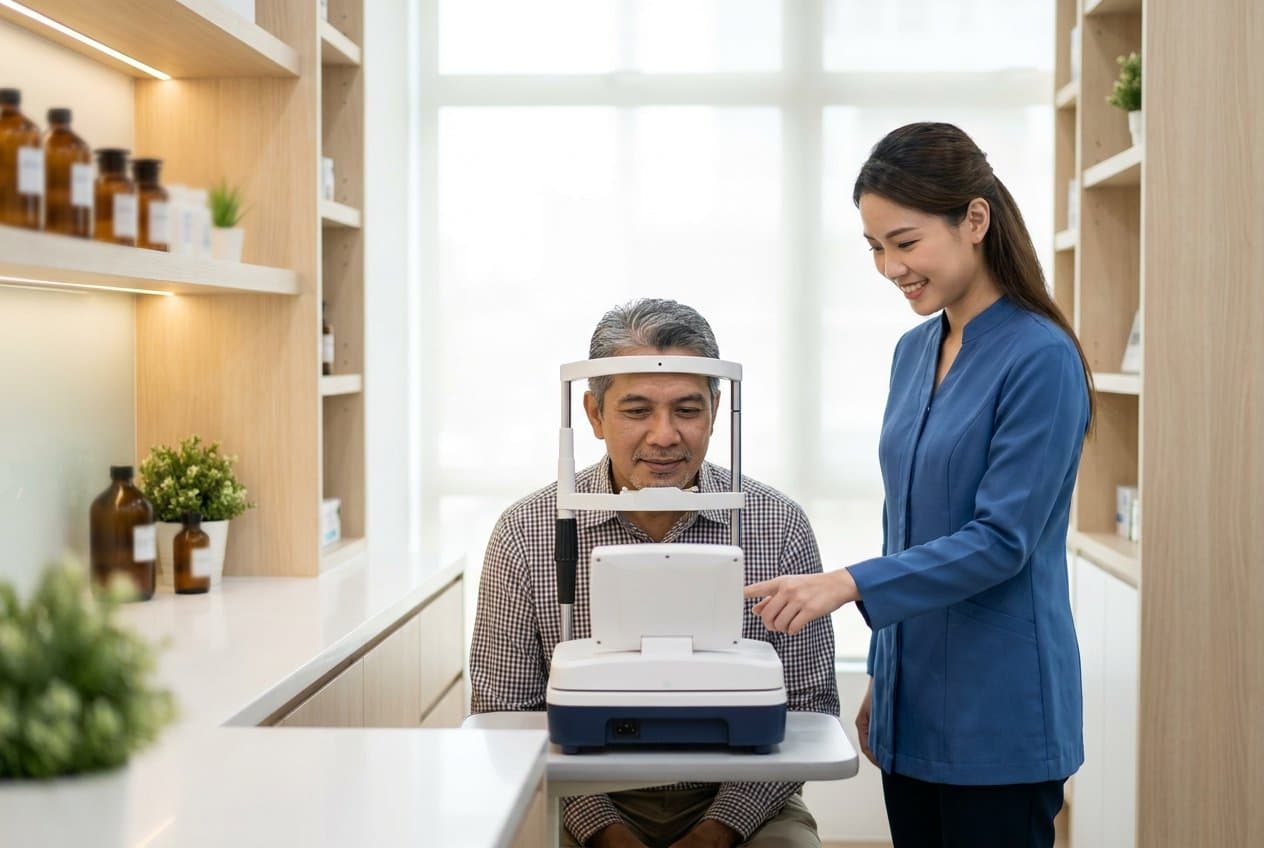
- You sit at the camera and rest your chin on the support.
- You look at a target light while the camera auto-focuses on each eye.
- A brief flash captures one image per eye — no eye drops, no dilation, no contact-lens removal needed for most cameras.
- The AI analyses the images and a report is ready in about three minutes.
The capture itself takes roughly a minute, and it is completely non-invasive. A few situations can make imaging harder — a history of eye surgery or laser treatment, or drooping eyelids can occasionally make the camera slower to focus or unable to capture a clear image — so mention these to the operator beforehand.
Who it's for
AI retinal screening is most useful as a preventive step — especially for adults with risk factors like a family history of diabetes, high blood pressure, high cholesterol, smoking, or simply age. Because it is fast and non-invasive, it fits naturally into a routine health check or a community screening day. It does not replace a full eye exam or your regular medical check-ups; it adds an early-warning layer on top of them.
The bottom line
An AI retinal scan turns a one-minute photo of your eye into an early read on both your eye health and your wider health risks. It won't diagnose disease on its own — but by surfacing problems years before symptoms appear, it gives you and your doctor the most valuable thing in preventive care: time to act.
CityMedic distributes Airdoc's AI retinal screening in Malaysia. To find a pharmacy, clinic or hospital offering the AI Enhanced Health Check near you, see our AI Health Check locator.
Frequently asked questions
Is an AI retinal scan painful or invasive?
No. It is completely non-invasive — you rest your chin on the camera and look at a target light while it takes a photo of each eye. There are no needles, and for most cameras no eye drops or pupil dilation are needed. The capture takes about a minute.
What can an AI retinal scan detect?
On the eye side it flags retinal abnormalities such as signs of diabetic retinopathy, macular degeneration and glaucoma indicators (Airdoc screens for around 25). It also estimates risk across roughly 10 whole-body areas, including arteriosclerosis, cardiovascular and glucose-metabolism risk, cognitive-impairment indicators and "retinal age".
Is the scan a diagnosis?
No. It is a screening and risk-assessment tool designed to flag people who may benefit from seeing a doctor — not to diagnose disease. Any elevated result should be confirmed by a clinician with proper examination and, if needed, further tests.
How accurate is AI retinal screening?
Leading systems are trained on tens of millions of retinal images and validated in real-world hospitals, with reported accuracy for some tasks around 90–95%. Accuracy varies by the specific condition, which is why a flagged result is always confirmed clinically.
How long does it take and do I need to prepare?
The scan takes about a minute and the AI report is ready in roughly three minutes. No special preparation is needed for most cameras. Mention any history of eye surgery, laser treatment or drooping eyelids to the operator, as these can occasionally make imaging harder.
Where can I get an AI retinal scan in Malaysia?
CityMedic distributes Airdoc’s AI Enhanced Health Check across pharmacies, clinics and hospitals in Malaysia. Use the locator on our AI Health Check page to find a screening point near you.