
Your Stress, Decoded: ANS Balance, Vitality & Stress Scores on Neuro AI
Medically reviewed by Pharmacist Cherlyn
The short answer
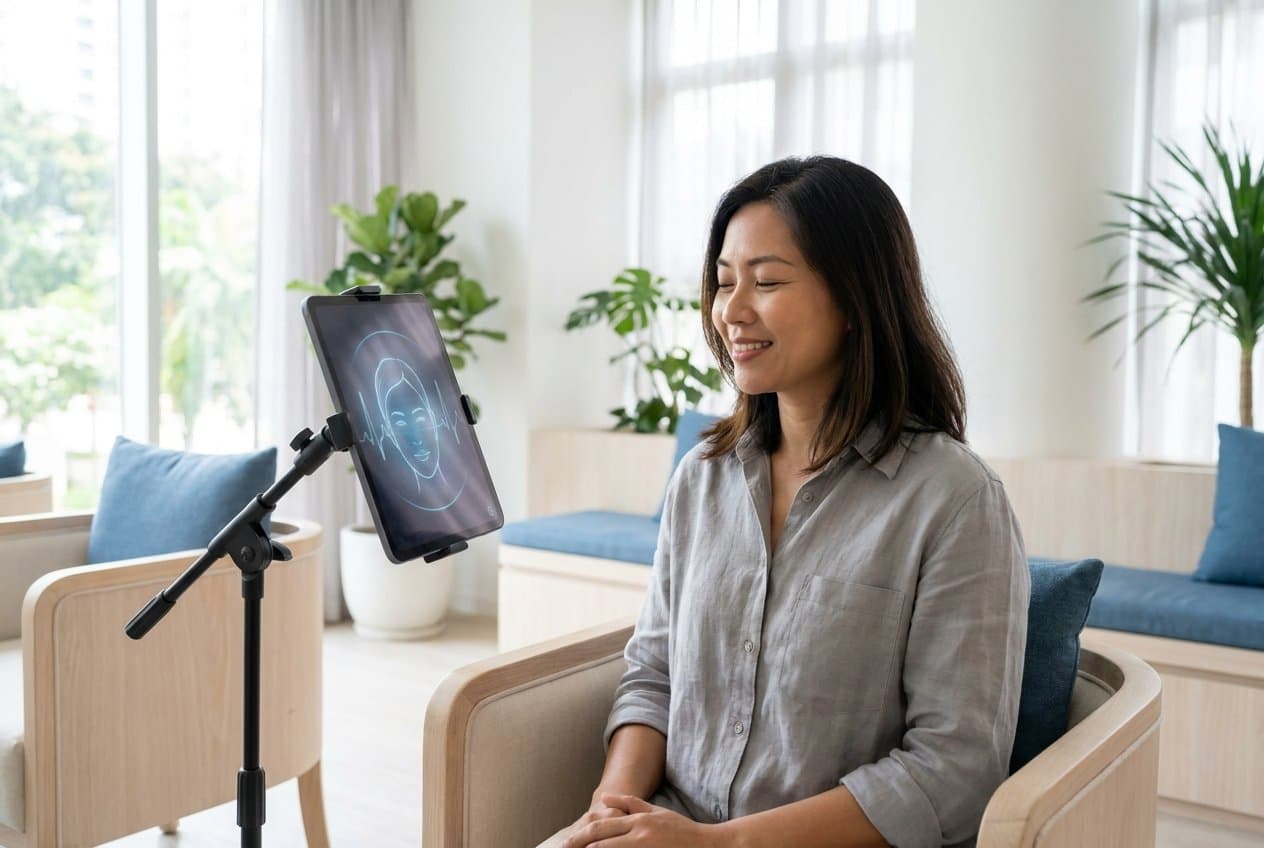
Neuro AI by Airdoc reads your autonomic nervous system from a short, contactless scan that combines four signals — heart-rate variability, pupil and eye dynamics (dilation, saccades, fixation), facial micro-expressions (action units) and facial temperature distribution. It reports five scores: ANS Balance (accelerator vs brake), ANS Vitality (reserve capacity), Psychological Stress (load from the mind), Physiological Stress (load from the body) and Stress Resilience (ability to recover). Read together and over time, they turn a vague sense of stress into a clear, trackable signal — a wellness screening aid, not a diagnosis.
Most health checks measure the machinery — your blood pressure, your cholesterol, your blood sugar. But there is another system working quietly in the background of every moment: the one that decides whether you are wound up or at ease, running hot or recovering. That is your autonomic nervous system, and Neuro AI by Airdoc is designed to read it.
From a short, contactless scan — no needles, no wires — Neuro AI reads several of your body's signals at once and turns them into five plain-language scores: ANS Balance, ANS Vitality, Psychological Stress, Physiological Stress and Stress Resilience. Here is what each one means, how the technology sees them, and how to read them together.
First, what is the autonomic nervous system?
Your autonomic nervous system (ANS) is the "autopilot" that runs the things you never consciously think about — heartbeat, breathing, pupil size, sweat, the release of stress hormones. It has two branches that work like an accelerator and a brake:
- The sympathetic branch is the accelerator — the "fight or flight" response that speeds you up under pressure.
- The parasympathetic branch is the brake — the "rest and digest" response that calms you down and lets you recover.
Good health isn't about pinning one branch on all the time. It's about flexibility — the ability to accelerate when you need to perform and brake when it's time to recover. The clever part of Neuro AI is that many of the body's autonomic signals show up on your face and eyes — so a camera-based scan can read them without touching you at all.
The signals behind the scores
Rather than rely on any single measurement, Neuro AI combines four streams of autonomic and emotional signal. Reading them together makes the result more robust than any one alone — each cross-checks the others.
- Heart-rate variability (HRV). The fine beat-to-beat variation in your pulse, captured contactlessly from subtle colour changes in your skin. HRV is one of the most established windows on the balance between the sympathetic and parasympathetic branches.
- Pupil & eye dynamics. The pupil is wired directly to the autonomic nervous system — the sympathetic branch widens it, the parasympathetic narrows it — so pupil dilation is a real-time arousal signal. Neuro AI also tracks saccades (the rapid flicks your eyes make between points) and fixation stability, which shift with fatigue, cognitive load and stress.
- Facial micro-expressions. Fleeting, involuntary movements of the facial muscles — coded as action units (the building blocks of the Facial Action Coding System) — reveal emotional and stress states that a person may not even be aware of, let alone able to hide.
- Facial temperature distribution. Autonomic activity constantly redirects blood flow under the skin, changing the heat map of your face (for example, the nose and periorbital areas shift with stress). Thermal patterns give an independent read on physiological arousal.
Together these four make Neuro AI a multimodal assessment — reading the nervous system the way an experienced clinician reads a patient: pulse, eyes, expression and complexion, all at once.
The five Neuro AI scores
1. ANS Balance
ANS Balance describes the tug-of-war between your accelerator and your brake — whether you are currently tilted toward stress-arousal (sympathetic) or toward recovery (parasympathetic).
- A balanced result means your nervous system is shifting appropriately — engaged when active, settling when at rest.
- A result skewed heavily toward the accelerator can reflect ongoing stress, anxiety or being "switched on" for too long.
- A result skewed hard toward the brake can reflect deep fatigue or exhaustion.
Think of it as a snapshot of your inner gear — are you in drive, or in neutral?
2. ANS Vitality
ANS Vitality is a measure of how much capacity — how much "autonomic energy" or reserve — your nervous system has to draw on. A vital, responsive ANS reacts quickly and adapts well; a depleted one responds sluggishly.
Higher vitality generally reflects a nervous system that is well-rested and adaptable. Lower vitality can accompany chronic stress, poor sleep, overtraining, illness, or simply the natural changes of ageing. If Balance is which way you're leaning, Vitality is how much fuel you have in the tank.
3. Psychological Stress
Psychological Stress estimates the load coming from your mind — mental workload, worry, emotional tension, pressure. This is the stress of a packed inbox, a difficult conversation, or a racing mind at 2 a.m. It draws especially on the emotional signals — micro-expressions and pupil arousal — alongside HRV.
A raised psychological-stress score is a prompt, not a diagnosis: it suggests your mental load is registering in your body, and that recovery habits — rest, breathing, boundaries, support — may be worth attention.
4. Physiological Stress
Physiological Stress estimates the load coming from your body — physical strain that is separate from your mood. Intense exercise, a poor night's sleep, illness, pain, inflammation, dehydration, caffeine or alcohol can all push it up.
Separating the two matters. You can feel calm yet carry high physiological stress (for example, after a hard workout or a bad night's sleep), or feel mentally frazzled while your body is physically fine. Seeing them apart helps you act on the right one.
5. Stress Resilience
Stress Resilience is the summary score most people care about: your capacity to withstand stress and bounce back from it. It reflects how readily your nervous system can absorb a demand and return to baseline — the physiological side of what we casually call being "resilient".
Higher resilience is associated with better recovery, adaptability and overall autonomic health. A lower score is an early nudge to protect the basics that rebuild it: consistent sleep, movement, recovery time, and stress-management habits.
Reading the five together
No single score tells the whole story — the picture comes from how they line up:
- High vitality + balanced + high resilience — your nervous system is in good shape and adapting well.
- High psychological stress + low resilience — mental load is outpacing your recovery; the priority is rest and stress management.
- High physiological stress + low vitality — your body is under physical strain (sleep, illness, overtraining); the priority is physical recovery.
- Everything low — a possible sign of deep fatigue or burnout worth discussing with a professional.
Because these are a snapshot in time, a single reading is less useful than a trend. Measuring at similar times of day, over weeks, shows how your habits — sleep, exercise, workload, breathing practice — actually move the numbers.
What Neuro AI is — and isn't
Neuro AI by Airdoc is a wellness and screening tool, not a diagnosis. Its scores are a way to make an invisible system visible — to notice strain earlier and to see whether the changes you make are working. They are not a substitute for medical assessment, and a concerning or persistent result should be discussed with a doctor.
Used well, though, it turns something most of us only sense vaguely — "I feel stressed", "I feel run down" — into a clear, trackable signal you can actually act on.
CityMedic distributes Airdoc's diagnostic-AI platform, including Neuro AI, in Malaysia. To talk to us about bringing Neuro AI to your clinic or screening programme, get in touch.
Frequently asked questions
What is the autonomic nervous system (ANS)?
It is the part of your nervous system that automatically runs functions you don’t consciously control — heartbeat, breathing, pupil size, digestion and the stress response. It has two branches: the sympathetic ("fight or flight") accelerator and the parasympathetic ("rest and digest") brake.
How does Neuro AI measure these scores?
From a short, contactless scan that reads four signals at once: heart-rate variability (beat-to-beat pulse variation captured from your skin), pupil and eye dynamics (dilation, saccades and fixation), facial micro-expressions (action units), and facial temperature distribution. No blood test, needle or wearable is required — combining several signals makes the result more robust than any single one.
Why does Neuro AI look at the eyes and face, not just the pulse?
Because the autonomic nervous system shows up there directly. The pupil is controlled by the ANS (sympathetic widens it, parasympathetic narrows it); micro-expressions reveal emotional and stress states; and autonomic activity changes facial blood flow, and therefore facial temperature. Reading the eyes, expression and complexion alongside the pulse gives a fuller, cross-checked picture.
What is the difference between ANS Balance and ANS Vitality?
ANS Balance shows which way your nervous system is leaning right now — toward stress-arousal or toward recovery. ANS Vitality shows how much capacity or reserve your nervous system has to respond and adapt. Balance is direction; Vitality is fuel in the tank.
What is the difference between psychological and physiological stress?
Psychological stress is load from the mind — mental workload, worry, emotional tension. Physiological stress is load from the body — exertion, poor sleep, illness, pain, caffeine. You can have one without the other, which is why Neuro AI reports them separately so you can act on the right one.
Are the Neuro AI scores a medical diagnosis?
No. Neuro AI is a wellness and screening tool that helps surface stress and autonomic strain earlier and track whether your habits are helping. It is not a diagnosis and does not replace medical assessment — discuss any concerning or persistent result with a doctor.