
Dr.Noon by Mediwhale: assessing heart-disease risk from a retinal photo
Medically reviewed by Pharmacist Cherlyn
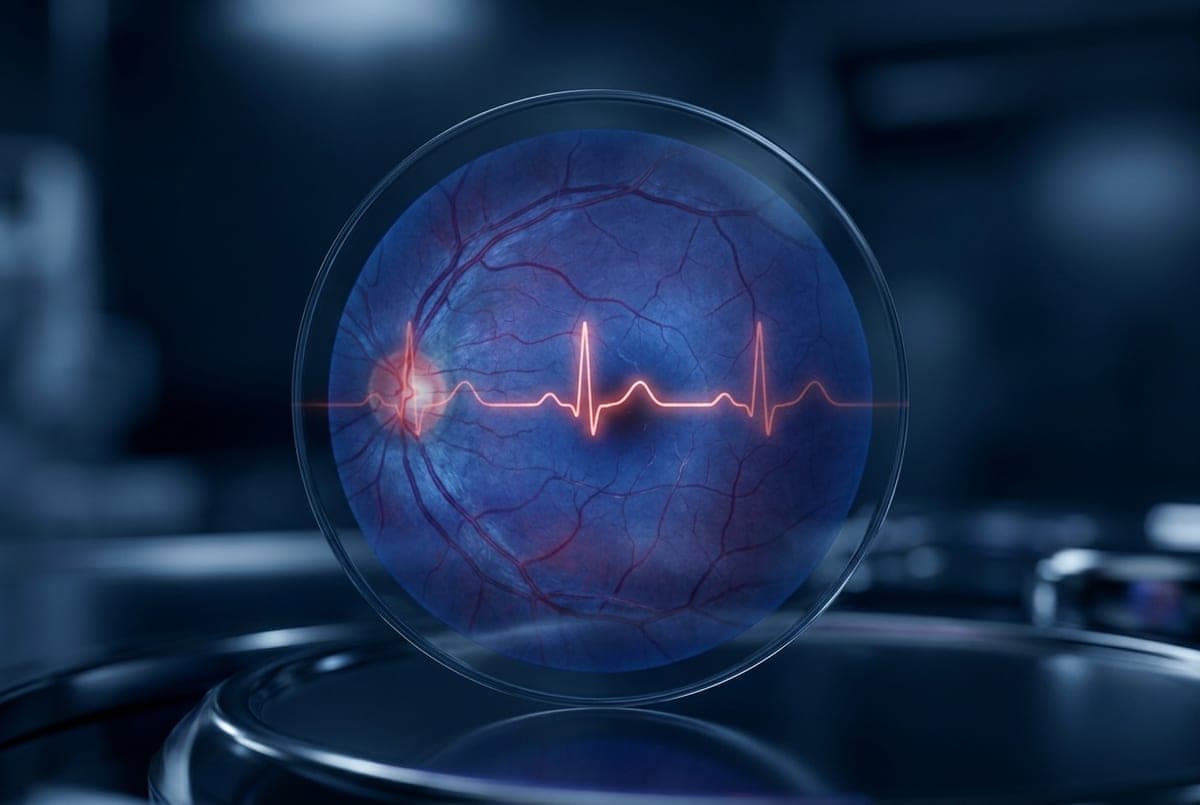
The short answer
Dr.Noon by Mediwhale uses AI to estimate your cardiovascular-disease risk from an ordinary retinal photograph — no blood test, no CT scan, no radiation. Across three peer-reviewed studies (The Lancet Digital Health, the European Heart Journal – Digital Health, and JAMIA), its retinal biomarker matched CT coronary-calcium scoring and standard risk calculators, and earned regulatory approval as a medical device.
Dr.Noon by Mediwhale answers a deceptively simple question: how much is your heart at risk? — using nothing more than a photograph of the back of your eye. CityMedic distributes it in Malaysia as part of our AI-diagnostics portfolio. What makes it credible isn't the idea alone; it's the clinical evidence behind it, published in three respected journals.
The idea: your heart risk, written in your eyes
The retina is the one place a doctor can see your blood vessels directly and non-invasively. The same processes that drive heart disease — atherosclerosis, high blood pressure, diabetes — leave subtle marks on these vessels. Dr.Noon's deep-learning model reads those marks to estimate cardiovascular risk. (For the bigger picture, see what is oculomics.)
Study 1 — The Lancet Digital Health (2021): a retinal "calcium score"
Coronary artery calcium (CAC), normally measured by a CT scan, is one of the strongest markers of heart-disease risk. Mediwhale's team trained an algorithm — RetiCAC — to predict CAC from a retinal photo, using 216,152 retinal photographs from five datasets across South Korea, Singapore, and the UK. RetiCAC out-performed every single clinical risk factor at detecting CAC, and its three-tier score predicted cardiovascular events with performance comparable to an actual CT calcium scan — but with no radiation and at far lower cost. It also added value on top of the standard US risk equation (the Pooled Cohort Equation).
Study 2 — European Heart Journal – Digital Health (2023): on par with the standard risk scores
The next question was whether the retinal biomarker (now Reti-CVD) agreed with the risk calculators doctors already trust. Tested on 48,260 UK Biobank participants and a multi-ethnic Singapore cohort (Chinese, Indian, and Malay), Reti-CVD identified intermediate- and high-risk individuals with over 80% sensitivity and specificity against all three major tools:
- vs the US Pooled Cohort Equation: 82.7% sensitivity, 87.6% specificity.
- vs the UK's QRISK3: 82.6% sensitivity, 85.5% specificity.
- vs Singapore's Framingham score: 82.1% sensitivity, 80.6% specificity.
Crucially, it held up across ethnicities — important for Malaysia's diverse population.
Study 3 — JAMIA (2024): a regulated pivotal trial
The strongest evidence is a regulated pivotal trial — the kind regulators require to approve a medical device. Following 1,106 people for five years, Reti-CVD's three risk tiers tracked real cardiovascular events closely (risk roughly doubling per tier; hazard-ratio trend 2.02). Head-to-head against other tests, it was non-inferior to CT coronary-calcium scoring and superior to carotid ultrasound and pulse-wave velocity (concordance index 0.75 vs 0.74 for CT calcium). When all markers were combined, the retinal score remained the standout predictor. These results led South Korea's regulator (K-MFDS) to authorise Reti-CVD as an AI medical device — the first regulated pivotal study of an image-based AI tool intended for future risk stratification rather than diagnosing current disease.
What it means in practice
Together, these studies make a consistent case: a quick retinal photo, read by Dr.Noon's AI, can flag cardiovascular risk about as well as tests that need CT scanners, ultrasound, or blood draws — but it's non-invasive, radiation-free, fast, and portable enough for a pharmacy, clinic, or community-screening setting. That makes it a powerful triage tool: identifying who should see a doctor, start preventive treatment, or get further tests, earlier and more accessibly. It pairs naturally with Airdoc retinal screening and complements blood-based checks like our cholesterol assessment.
The honest limits
Dr.Noon estimates risk — it does not diagnose a heart attack or replace a cardiologist's assessment, blood tests, or imaging where those are needed. The validation cohorts were Korean, Singaporean (multi-ethnic), and British; performance in other populations continues to be studied. And, as the papers transparently disclose, the research involved Mediwhale employees and shareholders — which is why the independent regulatory approval and peer-reviewed publication matter as added, external validation.
Sources: (1) Rim TH, Lee CJ, Tham Y-C, et al. Deep-learning-based cardiovascular risk stratification using coronary artery calcium scores predicted from retinal photographs. The Lancet Digital Health 2021; 3(5): e306–e316. (2) Yi JK, Rim TH, Park S, et al. Cardiovascular disease risk assessment using a deep-learning-based retinal biomarker: a comparison with existing risk scores. European Heart Journal – Digital Health 2023; 4(3): 236–244 (doi.org/10.1093/ehjdh/ztad023). (3) Lee CJ, Rim TH, Kang HG, et al. Pivotal trial of a deep-learning-based retinal biomarker (Reti-CVD) in the prediction of cardiovascular disease: data from CMERC-HI. JAMIA 2024; 31(1): 130–138 (doi.org/10.1093/jamia/ocad199). Educational summary, not medical advice.
Frequently asked questions
What is Dr.Noon by Mediwhale?
Dr.Noon is an AI tool from Mediwhale that analyses a standard retinal (fundus) photograph to estimate a person's future cardiovascular-disease risk — quickly, without blood tests, CT scans, or radiation. CityMedic distributes it in Malaysia.
Can a retinal photo really predict heart-disease risk?
Yes — the retina reveals the small blood vessels affected by cardiovascular disease. In peer-reviewed studies, Mediwhale's retinal biomarker predicted cardiovascular events and stratified risk, with accuracy comparable to a CT coronary-calcium scan.
Is it as good as a CT calcium scan?
In a regulated pivotal trial published in JAMIA (2024), the retinal biomarker was non-inferior to CT-measured coronary artery calcium for predicting cardiovascular events, and out-performed carotid ultrasound and pulse-wave velocity — without radiation.
Does it replace blood tests or a cardiologist?
No. It is a non-invasive risk-stratification and triage tool that flags who may benefit from closer assessment or preventive treatment. Diagnosis and treatment remain with your doctor.